
Structure of the Examination
This page presents the structure of the Matriculation Examination. Completing the examination begins when the candidate first enrols to take tests in the Matriculation Examination.
The Matriculation Examination must include tests in at least five subjects. All candidates must include the test in mother tongue and literature in their examination. In addition, the examination must include tests in at least four different subjects from at least three of the following groups: mathematics, the second national language, foreign languages, and humanities and natural sciences. The tests must include at least one test based on an advanced syllabus.

In addition to the five tests required for the examination, the candidate may take one or more additional tests. The candidate may, if they wish, take tests based on different syllabi in the same subject. However, tests based on different syllabi in the same subject may be counted only once towards the examination, for example basic and advanced mathematics or Evangelical Lutheran religion and Orthodox religion.
Instead of the second national language test, a candidate may choose to take the mother tongue and literature test in Swedish or Finnish intended for native speakers. A candidate may also choose to take, instead of a foreign language test, the test in mother tongue and literature in the Sámi language.
The Matriculation Examination Board has published an online tool that allows users to explore which combinations of tests meet these requirements. You can access the service here.
Graduation as a Matriculate
A candidate becomes a matriculate after successfully completing the tests required for the Matriculation Examination and the studies included in the general upper secondary school syllabus. Instead of the general upper secondary school syllabus, the candidate may have completed another qualification or studies provided for in legislation:
- a previously completed general upper secondary school syllabus or corresponding foreign education
- a vocational qualification referred to in the Act on Vocational Education and Training (531/2017), or a corresponding earlier qualification
- a vocational qualification of at least two years’ duration based on the basic education syllabus referred to in point 2, or a corresponding earlier syllabus, or equivalent studies, together with additional studies prescribed by the Matriculation Examination Board
The examination can still be completed despite a failed grade through compensation. Compensation may be applied if the grades in the candidate’s other tests demonstrate sufficient knowledge, skills and maturity, and if the candidate has not, in writing, prohibited the entry of a failed grade on the certificate. Compensation cannot be applied if a test has been deemed failed due to cheating or a breach of the examination regulations, or if the candidate has not attended the test session or submitted their test for assessment.
Taking the tests of the Matriculation Examination
The tests required for the examination must be completed within no more than three consecutive examination rounds. A failed test may be retaken three times during the next three examination rounds. If a candidate receives a failed grade in a test required for completing the examination in the third examination round, the completion of the examination may extend to up to six examination rounds. However, new tests may be added to the examination only during the first three consecutive examination rounds. If a candidate has chosen a more demanding level in a subject that offers tests at two levels and receives a failed grade, they may change the level when retaking the test. However, changing the level requires that the required tests still include at least one test at the more demanding level.
Illness, full-time studies abroad, or another comparable compelling reason may extend the time allowed for completing the examination by one to two examination rounds. If the completion of the examination is interrupted for such a reason and the candidate is unable to participate in all the tests during an examination round, the principal must submit a written application on the matter to the Matriculation Examination Board.
An approved test may be retaken without restriction. After completing the examination, a failed test may be retaken without restriction, and the examination may be supplemented with new subjects and syllabi.
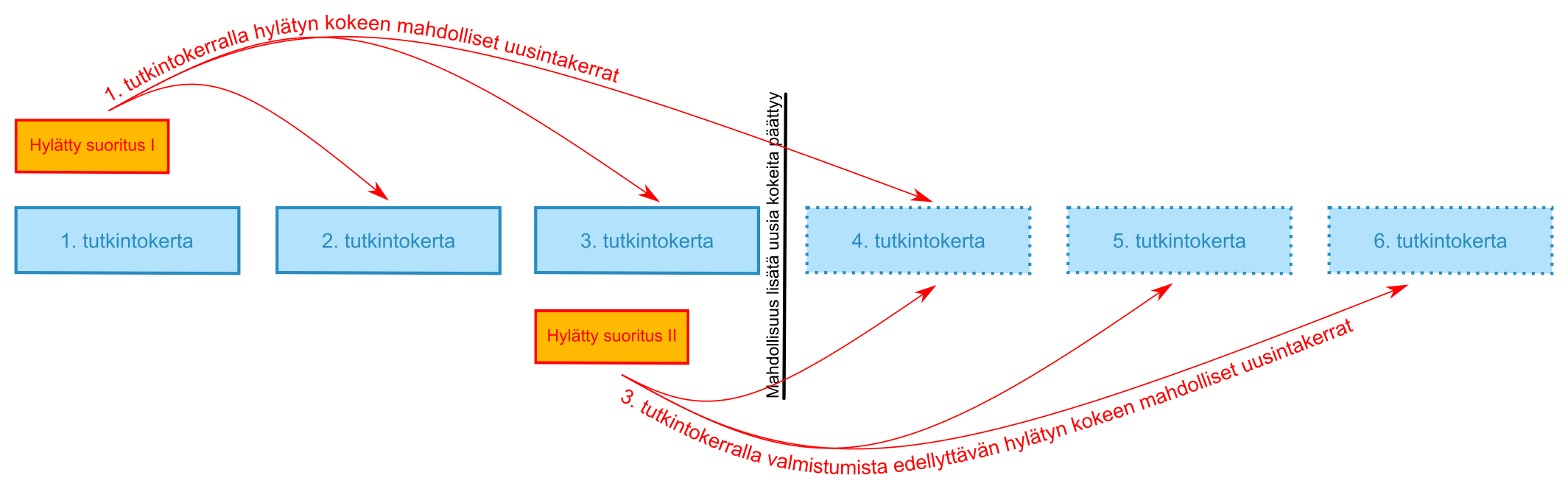
Restarting the examination
Upon application, and for particularly compelling reasons, the Matriculation Examination Board may decide that a candidate may restart the examination from the beginning while it is still incomplete.
The examination is deemed to have been failed if the candidate has not completed it within the time frame consisting of three examination rounds, the examination rounds allowed for retaking failed tests, and any extensions granted due to interruption of the examination. In such a case, the candidate may start completing the examination again. The candidate may include in the new examination any tests previously passed as part of the failed examination for up to three years from the date on which the test was passed.
A candidate may take matriculation examination tests as a separate qualification if they have not completed the Matriculation Examination and are not studying in general upper secondary education to complete the syllabus and the Finnish Matriculation Examination, or studying in vocational education and training to complete a vocational upper secondary qualification. Separate tests do not constitute a Matriculation Examination. If a candidate who has taken separate tests later wishes to complete the Matriculation Examination, any tests passed as separate tests may be included in the examination for up to three years from the date on which the test was passed.
Taking tests free of charge
The extension of compulsory education affects the fees charged for the Matriculation Examination. Free of charge provision mainly applies to students who start general upper secondary school in autumn 2021 or later. Compulsory education and free provision apply only to persons permanently residing in Finland. They do not apply to students whose municipality of residence is in Åland.
A candidate may enrol for the first five tests free of charge. A fee is charged for any additional tests. If a candidate enrols for several tests in the same examination round so that the total exceeds five, the candidate may choose which tests are to be taken free of charge.
If a candidate receives a failed grade in a test taken free of charge, they may retake the test free of charge, with certain exceptions. A fee is charged for retaking a failed test, for example, in the following cases:
- the candidate’s test is failed because the candidate did not attend the test session
- the candidate’s test is failed because the candidate did not submit their test for assessment
- the candidate’s test is failed due to misconduct or disruption of the test session
Free provision does not necessarily cover all five tests required to complete the Matriculation Examination if the candidate takes more than the required five tests. However, completing the first five tests, including any retakes of failed tests, enables the candidate to complete the Matriculation Examination free of charge, which has been the aim of extending compulsory education.
Compulsory education and the right to free education are being extended one cohort at a time. The right to free general upper secondary education and the Matriculation Examination applies, as of autumn 2021, to students who transfer directly to general upper secondary school from comprehensive education. Similarly, the right to complete a double qualification, i.e. a vocational upper secondary qualification and the Matriculation Examination, free of charge is being extended one cohort at a time.
As a rule, the right to free education ends when the student has completed the Matriculation Examination, a vocational qualification, or equivalent studies completed abroad. If a student is simultaneously completing vocational education and the general upper secondary school syllabus, the right to free education ends when the student has completed both the vocational qualification and the Matriculation Examination.
If a student progresses at a different pace from their age group or follows a non-standard study path, their right to take tests free of charge must be assessed on the basis of their study records and the applicable legislation. Provisions on free education include, for example:
- The right to free education ends at the end of the calendar year in which the student turns 20, unless an extension is granted.
- Compulsory education and the right to free education do not apply to students whose obligation to complete comprehensive education ended before 1 January 2021.
- The right to free education does not apply to students who have not been subject to compulsory education under the new legislation (for example, students who moved to Finland after reaching the age of compulsory education).
Further information on the right to free education and the extension of compulsory education is available on the website of the Ministry of Education and Culture.
Taking tests at different levels
A candidate may add new subjects and syllabi to their examination during three examination rounds. After three rounds, the candidate must have accumulated a sufficient number of subjects and syllabi to meet the requirements for completing the examination.
The examination must include at least one test based on the advanced syllabus. This means that the candidate may, for example, have completed both the advanced and basic syllabus in mathematics or in English.
If a candidate has not completed the required general upper secondary school courses or other studies required for the examination within three examination rounds, it is no longer possible to change the syllabus level or add new tests, unless the change concerns switching a failed test from the advanced syllabus to the basic syllabus (Section 16(2) of the Matriculation Examination Act). In such cases, the candidate must still have completed an advanced syllabus in another subject.
Once the candidate has completed the required general upper secondary school courses or other studies and the tests required for the Matriculation Examination, they become a matriculate. After this, they may supplement their examination freely with tests based on different syllabi.